

What Does It Mean To Draw Hears

Conventional centre symbol


A typical depiction of the Sacred Heart (often shown with other attributes, e.g. surmounted by a cross, pierced past nails or swords, etc.)
The center symbol is an ideograph used to express the thought of the "heart" in its metaphorical or symbolic sense. Represented by an anatomically inaccurate shape, the heart symbol is oftentimes used to represent the center of emotion, including affection and honey, specially romantic beloved. It is sometimes accompanied or superseded by the "wounded heart" symbol, depicted equally a heart symbol pierced with an arrow or as a heart symbol "broken" into two or more pieces, indicating lovesickness.
History [edit]
Origins [edit]
Heart-shaped peepal leaves were used in artistic depictions of the Indus Valley Civilisation: a heart pendant originating from there has been discovered and is now exhibited in the Delhi national museum.[1] In the 5th–6th century BC, the middle shape was used to represent the heart-shaped fruit of the found silphium,[2] a plant maybe used as a contraceptive.[3] Silver coins from Cyrene of the 5th–sixth century BC bear a similar design, sometimes accompanied by a silphium plant and is understood to represent its seed or fruit.[4]
Earliest use [edit]
The combination of the heart shape and its use within the centre metaphor was developed in the cease of the Middle Ages, although the shape has been used in many ancient epigraphy monuments and texts. With possible early on examples or direct predecessors in the 13th to 14th century, the familiar symbol of the eye representing honey developed in the 15th century, and became pop in Europe during the 16th.[5]
Before the 14th century, the middle shape was not associated with the meaning of the heart metaphor. The geometric shape itself is constitute in much earlier sources, just in such instances does not depict a middle, but typically leafage: in examples from antiquity fig leaves, and in medieval iconography and heraldry typically the leaves of ivy and of the water-lily.
The first known depiction of a middle as a symbol of romantic love dates to the 1250s. It occurs in a miniature decorating a majuscule 'S' in a manuscript of the French Roman de la poire .[half-dozen] In the miniature a kneeling lover (or more precisely, an allegory of the lover'southward "sugariness gaze" or doux regard ) offers his centre to a damsel. The center here resembles a pine cone (held "upside downwards", the point facing upward), in accord with medieval anatomical descriptions. However, in this miniature what suggests a heart shape is only the consequence of a lover's finger superimposed on an object; the total shape outline of the object is partly subconscious, and therefore unknown. Moreover, the French title of the manuscript that features the miniature translates into "Novel Of The Pear" in English. Thus the heart shaped object would exist a pear; the decision that a pear represents a middle is dubious. Opinions therefore differ over this existence the first depiction of a middle as symbol of romantic love.[7]
Giotto in his 1305 painting in the Scrovegni Chapel (Padua) shows an allegory of charity (caritas) handing her eye to Jesus Christ. This heart is also depicted in the pine cone shape based on anatomical descriptions of the solar day (still held "upside downward"). Giotto's painting exerted considerable influence on later painters, and the motive of Caritas offering a heart is shown by Taddeo Gaddi in Santa Croce, past Andrea Pisano on the bronze door of the south porch of the Florence Baptistery (c. 1337), by Ambrogio Lorenzetti in the Palazzo Publico in Siena (c. 1340) and by Andrea da Firenze in Santa Maria Novella in Florence (c. 1365). The convention of showing the heart point up switches in the late 14th century and becomes rare in the first half of the 15th century.[7]
The "scalloped" shape of the now-familiar centre symbol, with a dent in its base, arises in the early 14th century, at kickoff but lightly dented, as in the miniatures in Francesco Barberino's Documenti d'amore (before 1320). A slightly later example with a more than pronounced dent is establish in a manuscript from the Cistercian monastery in Brussels.[8] The convention of showing a dent at the base of the heart thus spread at about the same time as the convention of showing the heart with its point downward.[9] The modern indented ruddy centre has been used on playing cards since the belatedly 15th century.[ten]
Various hypotheses attempted to connect the "heart shape" every bit it evolved in the Late Eye Ages with instances of the geometric shape in antiquity.[11] Such theories are mod, proposed from the 1960s onward, and they remain speculative, as no continuity betwixt the supposed ancient predecessors and the late medieval tradition tin be shown. Specific suggestions include: the shape of the seed of the silphium plant, used in aboriginal times equally an herbal contraceptive,[xi] [12] and stylized depictions of features of the homo female person body, such as the female'south breasts, buttocks, pubic mound, or spread vulva.[thirteen]
-

The earliest known possible visual depiction of a heart symbol, as a lover hands his center to the beloved lady, in a manuscript of the Roman de la poire , 13th century.
-

Giotto's allegory of charity handing her eye to Jesus Christ (c. 1305)
-
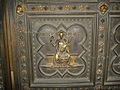
Charity on the south doors of the Florence Baptistery (c. 1336)
Renaissance and early on mod [edit]
Heart shapes can exist seen on various stucco reliefs and wall panels excavated from the ruins of Ctesiphon, the Persian capital (c. 90 BC – 637 AD).[fourteen] [fifteen] [xvi]
The Luther rose was the seal that was designed for Martin Luther at the bidding of Prince John Frederick, in 1530, while Luther was staying at the Coburg Fortress during the Nutrition of Augsburg. Luther wrote an explanation of the symbol to Lazarus Spengler: "a black cantankerous in a heart, which retains its natural color, so that I myself would be reminded that organized religion in the Crucified saves united states. 'For one who believes from the eye will be justified' (Romans 10:10)."[17] [ unreliable source? ]
The aorta remains visible, as a protrusion at the top centered betwixt the ii "chambers" indicated in the symbol, in some depictions of the Sacred Heart well into the 18th century, and is partly all the same shown today (although more often than not obscured by elements such as a crown, flames, rays, or a cross) just the "hearts" suit did non have this element since the 15th century.
The eye symbol reached Nihon with the Muromachi period Nanban trade of 1543 to 1614, every bit evidenced by a 14th century Muromachi-flow ritual axe for Yamabushi monks from the Shinshō-ji temple, donated to the Nara National Museum Collection,[18] and a afterward Edo period samurai helmet (dated c. 1630), which includes both the rounded and indented forms of the centre symbol, representing the heart of Marishiten, goddess of archers.[19]
-
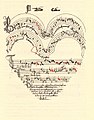
The chanson Belle, Bonne, Sage by Baude Cordier, written in the shape of a heart, in the Chantilly Codex. This is one of two dedicatory pieces placed at the beginning of the older (belatedly 14th century) corpus, probably to supplant the original beginning fascicle, which is missing.
-
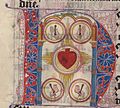
Early depiction of the Heart of Jesus in the context of the 5 Wounds (the wounded heart hither depicting Christ's wound inflicted past the Lance of Longinus) in a 15th century manuscript.[20]
-

1486 depiction of the Five Wounds
-
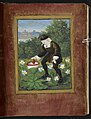
Miniature from the Petit Livre d'Amour (c. 1500), showing the author Pierre Sala depositing his middle in a marguerite flower (symbolizing his mistress, who was chosen Marguerite). Also worth mentioning is the miniature on fol. 13r,[21] showing two women catching winged hearts in a cyberspace.
-

Hearts conform in a 1540s High german deck of playing cards
-
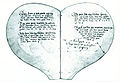
The Danish "Eye Book", a heart-shaped manuscript of love ballads from the 1550s.
-

Emblematic painting of the Sacred Heart of Jesus. The central heart radiates hearts gathered upwardly by Putti. By Robert la Longe, c. 1705.
-

Leaden heart of Raesfeld chapel (funerary casket containing the centre of Christoph Otto von Velen, d. 1733)
-

18th-century depiction of the Sacred Heart from the vision of Marguerite Marie Alacoque (d. 1690). The heart is both "heart shaped" and drawn anatomically correct, with both the aorta and the pulmonary avenue visible, with the crucifix placed inside the aorta.
-
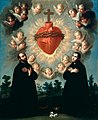
Another anatomically correct Sacred Heart, painted in c. 1770 by José de Páez.
Modern [edit]
Since the 19th century, the symbol has oftentimes been used on Valentine's Day cards, processed boxes, and similar popular culture artifacts as a symbol of romantic dear.
The use of the heart symbol as a logograph for the English verb "to love" derives from the apply in "I ♥ NY," introduced in 1977.[22]
Heart symbols are oftentimes used to symbolize "health" or "lives" in video games. Super Mario Bros. 2 (1987, 1988) had a "life bar" equanimous of hexagons, but in 1990s remakes of these games, the hexagons were replaced by heart shapes (the Castlevania franchise being a notable exception, where the hearts are armament for the secondary weapons instead of representing health). Since the 1990s, the center symbol has also been used equally an ideogram indicating health outside of the video gaming context, east.g. its use by restaurants to indicate heart-healthy nutrient content claim (e.one thousand. "low in cholesterol"). A copyrighted "heart-check" symbol to signal heart-healthy food was introduced by the American Heart Association in 1995.[23]
-
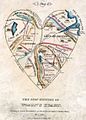
A heart-shaped "Map of Woman'southward Middle" (1830s)
-

Two called-for hearts, coloured pink, illustration on a Victorian-era Valentine's Day menu.
-

A "Vinegar Valentine" card from the 1870s, with a cerise heart symbol pierced by six arrows.
-

The traditional "heart shape" appears on a 1910 Valentine'southward Day card.
-

Sail music embrace of "Look in His Eyes", from the musical Accept a Eye (1913).
-

Magazine advertisement for the silent movie The Orderly (1921).
-

Wedding rings of a groom and bride with shadow in form of heart - symbolic of dearest.
Heraldry [edit]


The earliest heart-shaped charges in heraldry appear in the 12th century; the hearts in the coat of arms of Kingdom of denmark go back to the royal banner of the kings of Denmark, in plough based on a seal used as early on as the 1190s. Yet, while the charges are clearly heart-shaped, they did not describe hearts in origin, or symbolize whatever idea related to honey. Instead, they are assumed to have depicted the leaves of the water-lily. Early on heraldic eye-shaped charges depicting the leaves of water-lilies are found in various other designs related to territories shut to rivers or a coastline (east.thousand. Flags of Frisia).
Inverted heart symbols take been used in heraldry as stylized testicles (coglioni in Italian) as in the canting arms of the Colleoni family of Milan.[25]
A seal attributed to William, Lord of Douglas (of 1333) shows a center shape, identified as the centre of Robert the Bruce. The authenticity of this seal is "very questionable",[26] i.east. it could perchance date to the late 14th or fifty-fifty the 15th century.[27]
Heraldic charges actually representing hearts became more common in the early modern period, with the Sacred Middle depicted in ecclesiastical heraldry, and hearts representing love appearing in conservative coats of arms. Hearts besides subsequently became popular elements in municipal coats of artillery.
Botanical symbolism [edit]
There has been some conjecture regarding the link between the traditional centre symbol and images of the fruit of silphium, a (probably) extinct plant known to classical antiquity and belonging to the genus Ferula, used as a condiment and medicine, (the medicinal properties including contraceptive and abortifacient activity, linking the found to sexuality and love).[28] Argent coins from the ancient Libya of the 6th to 5th centuries BC carry images strongly reminiscent of the heart symbol, sometimes accompanied by images of the silphium constitute.[29] [30] The related Ferula species asafoetida - which was actually used as an inferior substitute for silphium - is regarded equally an aphrodisiac in Tibet and India, suggesting nevertheless a third amatory association relating to silphium.[31]
-

Ancient silver coin from Cyrene, Libya depicting the heart-shaped 'seed' (actually fruit) of silphium.
-

Ferula assa-foetida a species of giant fennel belonging to the same genus as the ancient silphium and regarded as having similar backdrop, while being an junior substitute for the plant.
Encoding [edit]
A common emoticon for the heart is <iii. In Unicode several heart symbols are bachelor in text format:
| Glyph | Description | HTML lawmaking | Alt codes |
|---|---|---|---|
| ❦ | U+2766 FLORAL HEART | ❦ | |
| ❧ | U+2767 ROTATED FLORAL HEART BULLET | ❧ | |
| ☙ | U+2619 REVERSED ROTATED FLORAL HEART BULLET | ☙ | |
| ♡ | U+2661 WHITE HEART Arrange | ♡ or ♡ | |
| ♥ | U+2665 Black HEART Adapt in device default representation | ♥ or ♥ or ♥ | Alt + iii |
| ♥︎ | U+2665 BLACK Middle Suit in explicit plaintext representation | ♥︎ | |
| ♥️ | U+2665 Blackness HEART Suit in explicit emoji representation | ♥️ | |
| ❤ | U+2764 HEAVY Blackness Eye in device default representation | ❤ or ❤ | |
| ❤︎ | U+2764 HEAVY BLACK HEART in explicit plaintext representation | ❤︎ | |
| ❤️ | U+2764 HEAVY Blackness HEART in explicit emoji representation | ❤️ | |
| ❥ | U+2765 ROTATED HEAVY Black HEART BULLET | ❥ or ❥ | |
| ❣ | U+2763 HEAVY HEART EXCLAMATION Marker Ornament | ❣ or ❣ |
And from the Miscellaneous Symbols and Pictographs and Supplemental Symbols and Pictographs ranges associated with emoji:
|
|
In Code page 437, the original character prepare of the IBM PC, the value of iii (hexadecimal 03) represents the heart symbol. This value is shared with the non-printing ETX control grapheme, which overrides the glyph in many contexts.
Parametrisation [edit]
A number of parametrisations of approximately eye-shaped curves have been described. The best-known of these is the cardioid, which is an epicycloid with one cusp;[32] though as the cardioid lacks the signal, it may be seen as a stylized water-lily leaf, a and so-called seeblatt, rather than a heart. Other curves, such every bit the implicit curve (x2+yii−1)3−xtwoy3=0, may produce better approximations of the heart shape.[33]
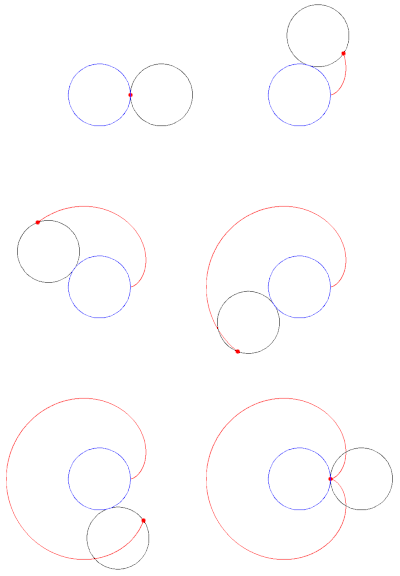
A cardioid generated by a rolling circle
(animated)

Implicit centre bend
(x2 + yii − one)three − ten2ythree = 0

Parametric plot of the curve

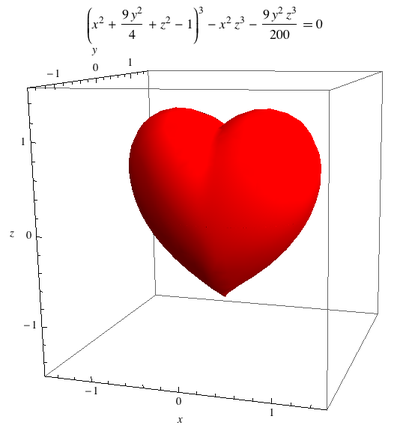
Implicit centre surface

Uncomplicated form made from two perpendicular lines and two round arcs.
-
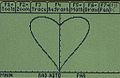
Center curve on TI-89 graphing reckoner
-

Parametric equation of heart curve on TI-89 graphing calculator
See besides [edit]
- Cordata, Cordatum and Cordatus, Latin adjectives meaning heart-shaped
- Passion (emotion), or passionate love
- Seeblatt, a symbol of a water lily leaf that resembles a middle
- Center in manus – Symbol of charity
References [edit]
Inline citations [edit]
- ^ "Pendant - unknown". Google Arts & Culture . Retrieved 2020-ten-21 .
- ^ Favorito, Eastward. N.; Baty, Thousand. (February 1995). "The Silphium Connexion". Celator. 9 (2): half-dozen–eight.
- ^ Did the aboriginal Romans use a natural herb for nascency control?, The Straight Dope, October xiii, 2006
- ^ Buttrey, T. V. (Bound–Summer 1992). "The Coins and the Cult" (PDF). Expedition. 34 (1–ii): 59–66.
- ^ Kemp (2011), 96–99.
- ^ (National Library FR MS. 2086, plate 12)
- ^ a b Vinken (2001).
- ^ MS 4459–lxx, fol 192v. Royal Library of Belgium
- ^ Vinken (2001): "The modify from the spherical to the scalloped form of the centre base happened more than or less in train with the differing way in which the middle was held, and has dominated visual representations of the heart ever since."
- ^ A Brief History of Playing Cardes, past Charles Knutson, Renaissance Magazine 2001 "Archived copy". Archived from the original on 2010-12-20. Retrieved 2013-05-27 .
{{cite web}}: CS1 maint: archived re-create as championship (link) - ^ a b The Shape of My Center: Where did the ubiquitous Valentine's symbol come from? past Keelin McDonell, Slate.com, Tuesday, February. xiii, 2007.
- ^ Benedictus, Luke (12 Feb 2006). "Sowing the seeds of love". The Historic period.
- ^ Proposed by Gloria Steinem in the 1998 introduction to the Vagina Monologues online copy [ permanent expressionless link ] ; "For example, the shape nosotros telephone call a middle—whose symmetry resembles the vulva far more than the asymmetry of the organ that shares its proper name—is probably a residuum female genital symbol. It was reduced from power to romance past centuries of male authorisation.", based on an earlier suggestion by Tanzer (1969) that the shape was used every bit a symbol indicating brothels in ancient Pompeii. Tanzer (1969). The Mutual People of Pompeii. A study of the graffiti. With illustrations and a map
- ^ Roundel with radiating palmettes. (n.d.). Retrieved April 7, 2015, from http://metmuseum.org/exhibitions/view?exhibitionId={60853040-AE7E-4162-8FA7-525505D6B633}&oid=322631
- ^ Fragments of stucco roundels in situ, Taq-i Kisra, south edifice, Ctesiphon, Iraq, 1931–32. (due north.d.). Retrieved April seven, 2015, from http://world wide web.metmuseum.org/met-around-the-globe/images/wb_large/wb_Ctesiphon2.jpg
- ^ "Wall panel with a republic of guinea fowl [Sasanian] (32.150.13)". In Heilbrunn Timeline of Art History. New York: The Metropolitan Museum of Art, 2000–. http://world wide web.metmuseum.org/toah/works-of-art/32.150.13 (March 2012)
- ^ gamesmuseum.uwaterloo.ca Archived 2006-10-10 at the Wayback Machine, i-p-c-s.org "Archived copy". Archived from the original on 2013-09-27. Retrieved 2013-03-17 .
{{cite spider web}}: CS1 maint: archived re-create equally championship (link) antiquemapsandprints.com, obviously more enquiry is needed hither. - ^ "Of import Cultural Holding|Ritual axe for mountaineering priest of Shugen sect|Nara National Museum".
- ^ Samurai helmet representing the flaming jewel, by Unkai Mitsuhisa ca 1630, Ann and Gabriel Barbier-Mueller Collection, exhibited at Boston Fine Arts Museum, April–August 2013.
- ^ Cologne Mn Kn 28-1181 fol. 116
- ^ fol. 13r
- ^ "Subsequently the centre symbol became a shorthand for enthusiasm for everything grade software to Yorkshire terriers. It was a postage stamp that validated lifestyles. People could ♥ their grandchildren or line dancing or Buddha." Stephen Amidon, Thomas Amidon, The Sublime Engine: A Biography of the Human Heart (2011), p. 193.
- ^ "the heart-check mark that began to appear on a wide assortment of food packaging in 1995. The symbol consists of a heart branded with a bold, efficient check marker. It is copyrighted past the American Heart Association (AHA) which licences it for a nominal fee to companies whose products meet the organization'south criteria for saturated fatty and cholesterol content." Stephen Amidon, Thomas Amidon, The Sublime Engine: A Biography of the Human Heart (2011), p. 193.
- ^ C. Weyers in: Stengel (ed.), Archiv für Diplomatik: Schriftgeschichte, Siegel, und Wappenkunde, Volume 54, 2008, p. 100.
- ^ Woodward, John and George Burnett (1969). Woodward's a treatise on heraldry, British and foreign, page 203. Originally published 1892, Edinburgh: W. & A. B. Johnson. ISBN 0-7153-4464-i. LCCN 02-20303
- ^ McAndrew, Scotland's Historic Heraldry, 2006, p. 141
- ^ McAndrew 2006, p. 213.
- ^ Favorito, E. N.; Baty, Thousand. (Feb 1995). "The Silphium Connection". Celator. 9 (2): 6–eight.
- ^ T. V. Buttrey, "The Coins and the Cult", Expedition magazine vol. 34, Nos. 1–ii "Special Issue: Gifts to the Goddesses—Cyrene's Sanctuary of Demeter and Persephone", Leap–Summer 1992.
- ^ Koerper, H.; Kolls, A. L. (1999). "The silphium motif adorning ancient libyan coinage: Marketing a medicinal plant". Economical Phytology. 53 (2): 133–143. doi:x.1007/BF02866492. JSTOR 4256173. S2CID 32144481.
- ^ "Aphrodisiac - Asafoetida (Ferula asa foetida)".
- ^ Weisstein, Eric W., "Cardioid" from MathWorld.
- ^ Eric Westward. Weisstein, "Heart Curve." From MathWorld
Works cited [edit]
- Martin Kemp, "The Heart" in Christ to Coke: How Prototype Becomes Icon, Oxford University Printing, 2011, 81–113.
- P. J. Vinken (2000), The Shape of the Heart: A Contribution to the Iconology of the Center (illustrated ed.), Elsevier Health Sciences, ISBN978-0-444-82987-0
General references [edit]
- Vinken, P (2001), "How the heart was held in medieval art", The Lancet, 358 (9299): 2155–2157, doi:x.1016/S0140-6736(01)07224-five, PMID 11784647, S2CID 37917232
External links [edit]

What Does It Mean To Draw Hears,
Source: https://en.wikipedia.org/wiki/Heart_symbol
Posted by: andersonvearguat.blogspot.com
0 Response to "What Does It Mean To Draw Hears"
Post a Comment